
Let me be honest with you. The moment I finish a tattoo and slide the machine back on the tray, my job is roughly half done. The other half belongs to you — the person walking out of the studio with fresh ink under a piece of second skin. What happens over the next four to six weeks decides whether that piece stays sharp for the next twenty years or turns into something you quietly regret every time you look in the mirror.
I’ve been tattooing since 2002, and if there’s one thing I wish every client understood before their first session, it’s this: tattoo aftercare is not a suggestion pinned to the end of an appointment. It’s the second half of the artwork. This guide walks you through the entire healing process — from the moment you leave the chair to the day your skin fully stabilizes — with practical, real-world instructions I give my own clients in Los Angeles.
A tattoo is a controlled wound. The needle punctures the epidermis and deposits pigment into the upper dermis, roughly one to two millimeters deep. Your body responds the way it responds to any injury of that scale — inflammation, plasma leakage, scab formation, and eventually regeneration. The pigment stays because it’s now embedded below the layer that sheds.
Understanding this changes how you treat the area. You’re not moisturizing a design; you’re helping an open wound close cleanly around ink that needs to settle without being disturbed. This is why proper tattoo aftercare instructions matter so much: every step exists to keep the wound clean, keep the pigment in place, and keep your immune system from overreacting.
Two things influence the outcome more than anything else — the quality of the work underneath and the discipline of the person healing it. I’ve watched flawless pieces go dull because a client hit the beach on day four. I’ve also watched heavy, dense work heal like a dream because the person followed instructions to the letter. The difference isn’t luck.
People love the idea of a “two-week heal,” and technicians on TikTok keep repeating it, but the reality is layered. Surface healing and deep healing are two different clocks running at the same time.
Surface healing — the part you can see — usually wraps up between day fourteen and day twenty-one. Deep healing, meaning the full regeneration of the dermis where the pigment lives, takes closer to two months. This is the difference between a tattoo that looks healed and a tattoo that is healed. The tattoo healing process doesn’t end when the peeling stops. It ends when the skin over your ink feels and behaves exactly like the skin next to it.
Here are the tattoo healing stages I walk every client through:
[This is an ideal place for an image showing a side-by-side comparison of a tattoo on day 1, day 7, day 14, and week 6]
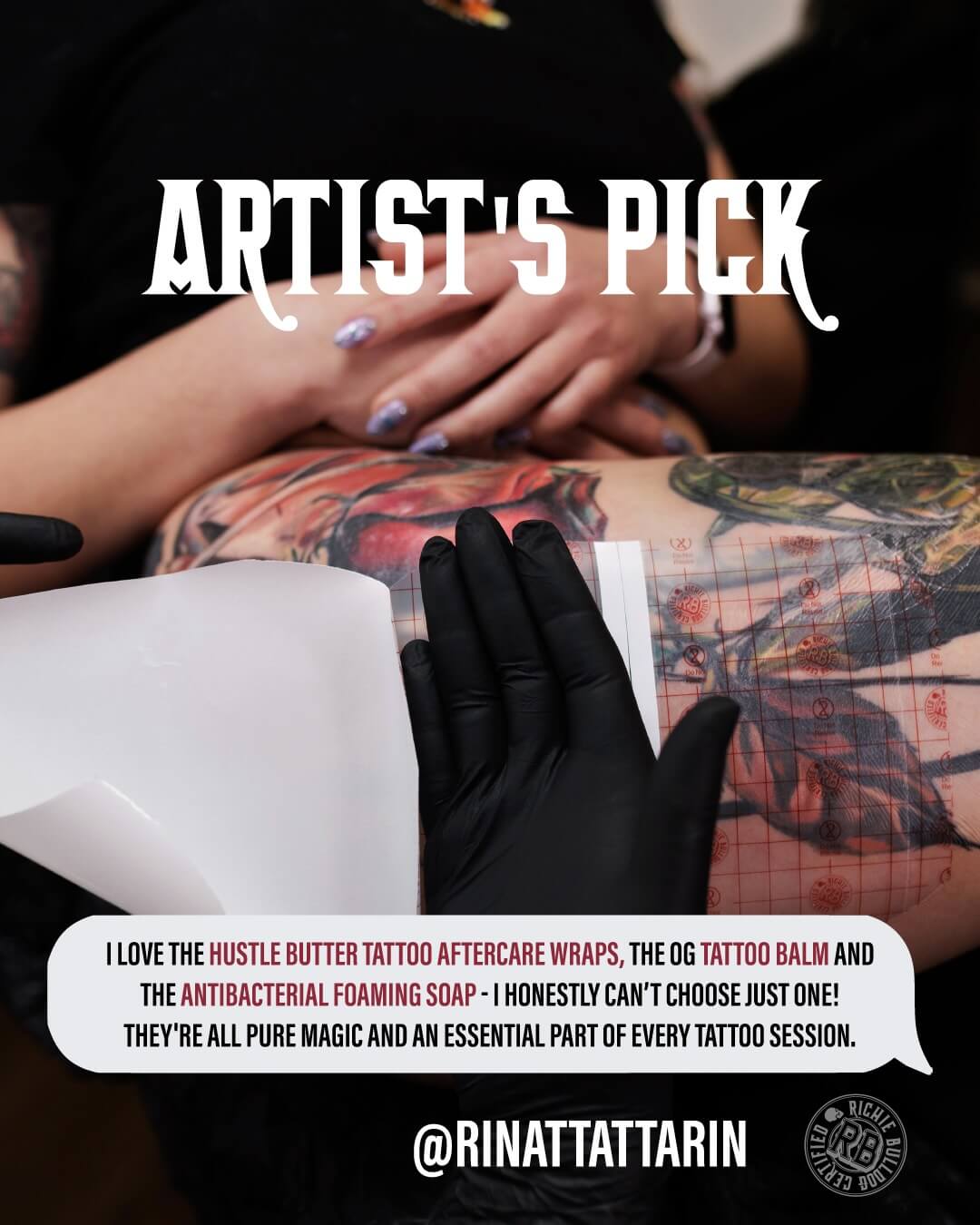
The first two days set the tone for everything that follows. Most modern artists — myself included — send clients home with a piece of medical-grade adhesive film, usually marketed as Saniderm, Dermalize, or Tegaderm. This transparent bandage creates a sealed, moist environment where your plasma does most of the healing work for you. It stays on for anywhere between 24 hours and five days, depending on the piece and how much fluid seeps out.
Here’s how to care for a tattoo during that window without overthinking it:
That’s it. No triple-coating. No hourly re-application. A tattoo doesn’t heal faster because you drown it in cream — it heals slower, because trapped moisture and product buildup suffocate the skin.
If your artist wraps you in traditional cling film instead of adhesive film, the timeline compresses. Remove the wrap after two to four hours, wash gently, and switch to open-air healing with light moisturization from that point on.
Here’s a tattoo aftercare routine that actually works, laid out day by day. I hand this same schedule to clients in the studio.
Expect fluid. Expect the tattoo to feel hot and look shinier than it will later. Wash twice a day. Moisturize twice a day with a thin coat. Sleep on clean sheets and, if possible, on the opposite side of the tattoo. Wear loose cotton over the area — no compression, no synthetic fabrics rubbing across fresh ink. This is proper tattoo care at its most basic.
The skin starts to feel drawn and dry. It may look slightly dull. Do not scratch. If you can feel yourself picking at scabs in your sleep, tape a soft cotton pad over the area at night. Continue washing once or twice a day. Moisturize only when the skin feels tight — usually two to three times daily is plenty. Some clients over-moisturize here and slow their own healing.
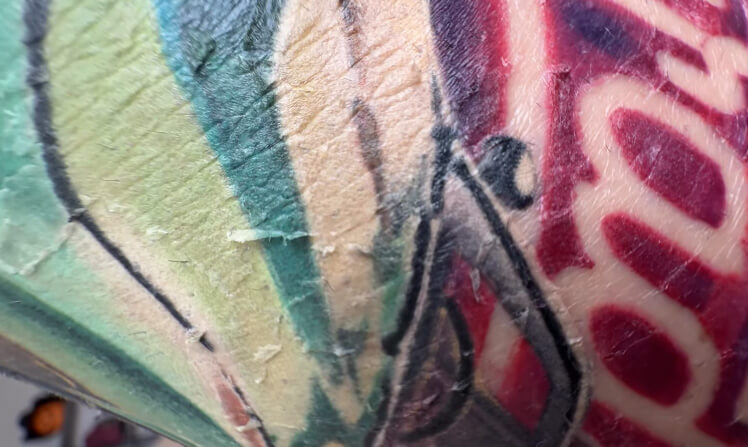
Peeling begins. Sheets of thin skin, sometimes tinted with the color of your tattoo, will come off in the shower or when you rub the area lightly with lotion. Do not peel them yourself. Ripping skin away too early can pull pigment with it and leave patchy spots that require touch-up work. Itching peaks here. A cool damp cloth pressed gently against the area for 30 seconds usually resets the itch reflex.
The tattoo looks strange. Slightly hazy, slightly muted, as if there’s a film over it. That film is a thin layer of new epidermis that hasn’t fully clarified yet. It will. Do nothing dramatic. Keep moisturizing lightly. Keep the tattoo out of direct sun.
Colors come back. Blacks deepen. The design starts to look like it did the moment you saw it in the mirror at the studio. Regular skincare can resume. Sunscreen becomes mandatory whenever the area is exposed.
Most botched heals aren’t caused by bad artists — they’re caused by everyday habits people don’t connect to their skin.
Sun exposure. UV radiation degrades tattoo pigment. On fresh ink, it can cause blistering, permanent color loss, and hyperpigmentation around the edges of the design. For the first six weeks, keep the tattoo out of direct sunlight entirely. After that, SPF 30 or higher, every time. The American Academy of Dermatology recommends broad-spectrum SPF 30 minimum for daily sun protection, and that guidance applies double to inked skin.
Water submersion. Baths, pools, hot tubs, oceans, and lakes are all off-limits for at least two to three weeks. Chlorine and salt disrupt healing skin. Standing water carries bacteria you can’t see. Showers are fine as long as you don’t let the stream hit the tattoo directly.
Gym and heavy sweating. Sweat carries bacteria and salt. Give it a week before returning to intense workouts, and clean the area gently right after. Avoid friction from equipment across the tattoo for at least two weeks.
Tight clothing. Anything that rubs, compresses, or sticks to the fresh tattoo is a problem. Waistbands over hip tattoos, bra straps over shoulder pieces, socks against ankle work — think ahead about your outfits for the first ten days.
Alcohol on day one. Alcohol thins the blood and increases plasma leakage, which slows early healing. One drink probably won’t ruin anything, but I ask clients to skip alcohol the day of and the day after their session.
Petting your pets. I’m not joking. Dog and cat fur carry bacteria and dander. Keep animals off your fresh ink for at least two weeks, especially at night.
Here are the small tattoo aftercare tips I’ve collected over roughly twenty-four years and five thousand clients. None of these show up in the printed handout, but they matter.
The market for tattoo aftercare products has exploded, and most of it is fine as long as the fundamentals hold: fragrance-free, dye-free, non-comedogenic, and thin in texture.
Here’s a quick comparison of the categories I recommend:
| Product Type | Best For | Watch Out For |
|---|---|---|
| Adhesive second skin (Saniderm, Dermalize) | Days 1–5, sealed healing | Reactions to adhesive in sensitive skin |
| Petroleum-based ointment (Aquaphor) | First 3–5 days after film removal | Over-application clogs skin |
| Plant-based balm (Hustle Butter, Ora’s Amazing) | Full healing, sensitive skin | Slight scent from shea/cocoa |
| Fragrance-free lotion (Lubriderm, Cetaphil) | Week 2 onward | Additives in scented versions |
There is no single “best” product. There’s the product that suits your skin, your climate, and the density of the work. In Los Angeles heat, I lean people toward lighter balms after the first week — heavy ointments in high humidity trap sweat and cause tiny breakouts across the tattoo.
This is easily the question I hear most often. The short answer: surface healing runs about two to three weeks; deep healing runs six to eight weeks. The longer answer: how long a tattoo takes to heal depends on several variables you can’t fully control.
Size matters — a small piece the size of a business card can close in ten days, while a full back seals over more slowly because the surface area is enormous. Placement matters — hands, feet, ribs, and elbows heal noticeably slower than shoulders or thighs because of movement and reduced circulation. Age matters — skin in your fifties simply regenerates more gradually than skin in your twenties. Lifestyle matters — smokers, heavy drinkers, and people running on chronic sleep debt heal slowly across the board.
For clients asking about tattoo recovery timelines before booking their next session, I tell them the same thing: wait at least four weeks between sessions on the same area, ideally six. If you push a needle back into skin that hasn’t finished healing at depth, you’ll fight scar tissue and blowouts, and the second session will hurt disproportionately more than the first.
The tattoo aftercare routine doesn’t really end at week six. It just changes.
Sunscreen is now permanent. Any dermatologist will tell you the single most important thing you can do for aging skin is daily SPF, and inked skin doubles down on that logic — UV breaks down tattoo pigment the same way it breaks down collagen. Moisturize the area daily, the way you’d moisturize your face. Hydrated skin holds pigment better and ages more gracefully.
Watch for changes in the moles or skin marks near your tattoo. Getting inked doesn’t cause skin cancer, but tattoos can obscure early signs of it. If you notice a mole under or beside a tattoo changing shape or color, get it looked at.
Small touch-ups are normal, even on flawless work. Areas with heavy movement — fingers, feet, elbows — sometimes need a light refresh after five to ten years. That’s not a failure of the tattoo; it’s the natural consequence of skin doing skin things.

A tattoo is a long-term relationship between your skin, your habits, and the pigment sitting quietly under the surface. Follow a straightforward tattoo aftercare routine for the first six weeks — clean it, moisturize it lightly, keep it out of the sun and out of the water — and you’ll set that piece up to look strong for decades. Cut corners, and even the best work in the world will show it.
If you’re getting inked in Los Angeles and want the healing plan tailored to the specific piece we’re doing, I go over it in detail during every consultation. Every design carries its own aftercare quirks — a dense biomechanical sleeve doesn’t heal quite like a delicate linework piece — and I’d rather spend fifteen minutes making sure you know exactly what to do than have you texting me on day three wondering if something looks off.
Reach out through the booking form when you’re ready. We’ll talk through the design, and we’ll talk through the healing.
How long does a tattoo take to heal completely: Surface healing takes two to three weeks. Full dermal healing — meaning the deeper layers of skin where the pigment sits — takes roughly six to eight weeks. What looks healed by week three isn’t fully stabilized until closer to week eight.
Can I shower with a new tattoo: Yes, from day one, as long as you don’t stand under direct spray. Keep showers short and lukewarm. Avoid soaking, and pat the tattoo dry with a clean paper towel afterward. Baths, pools, and hot tubs are off-limits for at least two to three weeks.
What if my tattoo is peeling and the color looks faded: Completely normal. Peeling starts around day eight to ten, and the pigment often looks cloudy or dull underneath. The final color comes back into focus by the end of week three, once the fresh layer of epidermis fully clarifies.
Do I need special tattoo aftercare products or can I use regular lotion: Special isn’t required. What matters is that whatever you use is fragrance-free, dye-free, and applied in a thin layer. Aquaphor, Hustle Butter, plain Cetaphil, and Lubriderm all work well when used correctly.
When can I go back to the gym after a tattoo: Light cardio is usually fine after five to seven days if there’s no friction on the tattooed area. Heavy lifting, contact sports, and anything that soaks the tattoo in sweat should wait about two weeks. Clean the area gently right after any workout during the healing window.